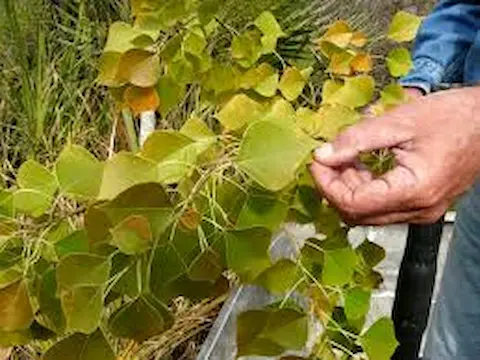
Late-Winter Chinese Tallow Cutting in Chalmette LA
Chinese tallow trees are one of the most aggressive invasive species in St. Bernard Parish, and if you own property in Chalmette, you've likely seen them reclaim cleared lots, push through fence lines, and crowd out native hardwoods within a single growing season. What many property owners don't realize is that timing matters enormously when it comes to cutting these trees. Late winter — roughly late January through mid-March in southeast Louisiana — creates a specific biological window that makes stump treatment significantly more effective. Understanding that window is the difference between a tree that doesn't come back and one that sends up a dozen new sprouts by May.
Why Late Winter Cuts Outperform Summer Removal
Chinese tallow trees are remarkably adaptive. Cut one down in the heat of summer and the stump will almost immediately push out vigorous sprouts from the root crown. The tree has plenty of stored energy and a full growing season ahead. Cut one in mid-January and you're catching it at the end of its dormancy, just as biological pressure begins building again from the roots upward. This is the key: as late winter progresses toward early spring, sap begins moving upward through the vascular tissue. Any herbicide applied to the freshly cut stump surface gets carried actively into the root system rather than just sitting on dead wood. That translates to faster kill rates and far less regrowth.
For property owners in Chalmette dealing with established tallow stands, this isn't a minor timing detail — it's the primary variable controlling whether you'll need to revisit the same trees again in two years. Late winter cuts combined with proper treatment can stop regrowth reliably. Summer cuts without chemical intervention almost never do.
What the Dormant-to-Active Transition Looks Like in Chalmette
Southeast Louisiana doesn't have a hard winter in the way northern states do, which means Chinese tallow dormancy here is shallow and brief. By late February, you'll often see early leaf bud swelling on tallow trees even when nights are still cool. That visual cue — buds beginning to swell but leaves not yet fully opening — marks the ideal treatment window. The tree is transitioning from dormant to active, sap movement is increasing, and the vascular system is primed to transport whatever is applied to the cut surface.
If you wait until March in St. Bernard Parish, you're often past the best window. Warm spring temperatures arrive quickly here, and by the time tallow trees are leafing out fully, their energy reserves have shifted toward above-ground growth rather than root absorption. Early-to-mid February cuts, when nights still dip into the 40s but daytime temps push into the 60s, tend to produce the best results in this part of Louisiana.
Stump Treatment Methods That Work
The most common and effective approach for late-winter Chinese tallow cutting is the cut-stump method using a concentrated triclopyr-based herbicide applied immediately after felling. "Immediately" is not an exaggeration — ideally within minutes of the cut, before the vascular tissue at the stump surface begins drying or oxidizing. The herbicide is applied directly to the cambium ring around the outer edge of the stump, which is where active transport occurs.
For larger diameter trees common in Chalmette's older neighborhoods and along drainage ditches, basal bark treatment is sometimes used as a complement or alternative. This involves applying oil-soluble herbicide to the lower 12 to 18 inches of the bark, which absorbs through the bark into the vascular tissue. Late winter conditions — cool but not freezing temperatures, dry bark — are favorable for basal bark treatment absorption.
What doesn't work reliably is cutting alone without any herbicide application, regardless of season. Chinese tallow's root system stores substantial energy, and a bare stump will resprout aggressively. If you've seen a cut tallow send up a ring of green shoots within weeks, that's the root system doing exactly what it evolved to do.
Permits, Access, and Practical Considerations in St. Bernard Parish
Chalmette and the broader St. Bernard Parish area don't require a permit for removing invasive species like Chinese tallow on private property in most cases, but it's worth confirming current local ordinances before work begins, particularly if trees are adjacent to drainage infrastructure or parish right-of-ways. The Louisiana Department of Agriculture and Forestry has identified Chinese tallow as a noxious invasive, and removal is actively encouraged — but work near drainage canals or public corridors may involve coordination with the parish.
Access is a practical concern on many Chalmette properties. Tallow stands often develop in low-lying or wet areas — exactly the kind of terrain that's common in St. Bernard Parish. Late winter is actually advantageous here too, since the ground is typically firmer before spring rain events and summer saturation. Equipment access through softer areas is easier in February than in June.
If you're evaluating the scope of a removal project on your property, our Chinese Tallow Removal service page outlines the process and can help you understand what a professional assessment involves. For broader context on how invasive removal projects are typically approached in this area, the earlier invasive tree removal walkthrough covers the full site evaluation and treatment sequence in detail.
What to Expect After Late-Winter Cutting
Even well-executed late-winter cuts with proper herbicide application don't produce instant results. Tallow stumps may still attempt to push sprouts in the weeks following treatment — this is normal and doesn't necessarily mean the treatment failed. The difference is that treated stumps produce weaker, shorter-lived sprouts that don't establish. Untreated stumps produce vigorous growth that re-establishes within a single season.
Follow-up monitoring through spring is recommended. If significant sprouting occurs by April or May, a second treatment application may be warranted. For large, established stands with extensive root systems — which are common on Chalmette properties that haven't been actively managed — multiple treatment seasons are sometimes necessary to achieve full control. The late-winter window is your most productive entry point each year for that ongoing management.
Getting the Timing Right for Your Property
The practical takeaway for Chalmette property owners is straightforward: if you've been planning to address a Chinese tallow problem, late winter is the time to act. The biology favors effective treatment, the ground conditions are typically workable, and getting ahead of the spring growth surge prevents another season of spread. A stand that doubles in size each year becomes exponentially more costly to address. Starting the process during the dormant-to-active transition window gives you the best shot at a clean result with fewer retreatment cycles down the road.
