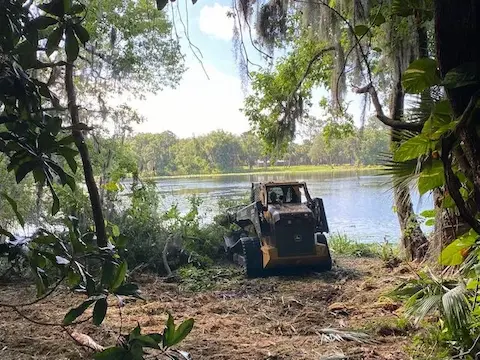
Flood Zone Tree Management for St. Bernard Parish Yards
St. Bernard Parish sits in one of the most hydrologically complex landscapes in the country. Flanked by Lake Borgne, the Mississippi River Gulf Outlet, and a sprawling network of drainage canals, nearly every residential yard in the parish qualifies as a flood zone in some technical or practical sense. That reality shapes everything about how trees grow here — and how they fail. Understanding flood zone tree management means accepting that the rules of conventional arboriculture apply unevenly when your soil alternates between saturated and drought-stressed several times a year.
Why Flood Zones Create Unique Tree Stress Patterns
Trees tolerate flooding to varying degrees, but even the most water-tolerant species suffer when inundation is prolonged, repeated, or arrives at the wrong point in the growing season. In St. Bernard Parish, the threat isn't just hurricane surge. Localized street flooding during heavy rain events, tidal backflow through drainage systems, and subsidence-driven ponding all create micro-flooding events that accumulate over time.
The core problem is oxygen deprivation. When soil pores fill with water, roots are cut off from the aerobic environment they need to function. Within 24 to 48 hours of complete saturation, oxygen-sensitive root tips begin dying back. If this happens repeatedly across multiple growing seasons, even established trees develop what arborists call chronic root dieback — a progressive weakening that isn't visible in the canopy until damage is already severe. By the time leaves show symptoms, structural compromise may already be significant.
Compounding the issue is the way flooding interacts with St. Bernard's clay-heavy soils. Saturated clay becomes almost impermeable, creating anaerobic pockets that persist long after surface water recedes. Root systems trapped in these pockets suffocate slowly, and the subsequent decay produces sulfurous compounds that further inhibit new root development. This is why trees in flood-prone yards often show healthy canopies one season and sudden catastrophic decline the next.
Species That Perform Well in Wet Site Conditions
Not all trees belong in flood-prone landscapes, and selecting the right species is the single most consequential decision in wet site arboriculture. St. Bernard Parish homeowners sometimes inherit landscapes planted decades ago with species that were poorly suited to begin with — or were planted before modern flood risk maps redrew how we understand local hydrology.
Native and naturalized species with documented flood tolerance include bald cypress (Taxodium distichum), water tupelo (Nyssa aquatica), swamp white oak (Quercus bicolor), and overcup oak (Quercus lyrata). These trees have evolved specifically for the intermittent flooding cycles common to Louisiana wetland margins. Their root systems include specialized aerenchyma tissue that allows oxygen transport even in saturated conditions.
For yards that flood occasionally but drain within a few days, the candidate list expands to include live oak (Quercus virginiana), green ash, and certain cultivars of red maple. Live oaks in particular have performed remarkably well across St. Bernard after Katrina and subsequent flood events, largely because their spreading root architecture distributes anchoring across a wide area rather than concentrating it in a central taproot that flood-softened soil cannot reliably hold.
Species to avoid in low-lying areas include Bradford pear, silver maple, Leyland cypress, and most conifers outside of bald cypress. These trees either develop shallow, destabilizing root systems in wet soils or lack the physiological adaptations to survive repeated anaerobic episodes. Removing these species and replacing them proactively is almost always the more cost-effective choice compared to emergency removal after failure.
Root Zone Aeration and Soil Remediation Techniques
For trees already established in flood-prone yards, proactive soil management can extend functional lifespan and reduce structural risk significantly. Root zone aeration is among the most effective interventions available for wet site trees.
Air spading — using compressed air to excavate soil without damaging roots — allows arborists to break up compacted, anaerobic zones around the root flare and in the critical root zone. Once the compacted layer is loosened, compost amendments and coarse organic material can be incorporated to improve drainage and restore aerobic conditions. In some cases, vertical mulching — drilling a grid of holes around a tree and filling them with organic material — achieves similar results with less soil disturbance.
Raised planting beds and engineered fill areas provide another option for new installations. By building up grade by six to twelve inches using well-draining amended soil, you create a root environment that remains aerobic longer during flood events. This technique is particularly useful along fence lines and foundation plantings where drainage is structurally impeded.
Mycorrhizal inoculation deserves mention here as well. Flood-damaged soils often lose beneficial fungal communities that help roots extract phosphorus and resist pathogens. Reintroducing mycorrhizal fungi at planting — or treating established trees through root zone injection — can meaningfully improve recovery rates after inundation stress.
Structural Risk Assessment After Flood Events
Every major flood event in St. Bernard Parish should trigger a professional structural assessment of mature trees on your property. The reason is straightforward: flood-softened soil dramatically reduces the anchoring capacity of root systems, and this effect persists for weeks after water recedes. A tree that passes visual inspection immediately after a flood may still be at elevated risk of windthrow during a subsequent storm because its root plate has not yet reestablished firm purchase in the soil.
Risk audits typically evaluate five factors: root plate integrity, presence of basal decay, canopy weight distribution, lean angle relative to baseline, and proximity of potential targets (structures, utility lines, vehicles, pedestrian areas). For trees over 30 feet in height near occupied structures, formal assessment using resistograph drilling or sonic tomography can detect internal decay that external inspection cannot reveal.
Documentation matters in St. Bernard Parish's regulatory context. If a tree presents a demonstrable hazard and you can show documented assessment and attempted remediation, you may have stronger standing in conversations with your insurer and, if removal becomes necessary, with the parish regarding tree removal permits near waterways and drainage corridors. Flood Zone Tree Management from a licensed local arborist provides exactly this kind of documented, defensible assessment for property owners navigating post-flood risk.
Common Mistakes in Flood-Zone Tree Care
Several well-intentioned practices actually make flood zone trees more vulnerable rather than less. Understanding these mistakes can prevent costly errors.
Topping trees to reduce wind load is perhaps the most damaging intervention. Topping removes the terminal growth points that direct a tree's energy, forcing it to produce multiple weakly attached epicormic shoots. These shoots grow rapidly and create a canopy that is structurally weaker than the original, while the topping wounds frequently introduce wood decay fungi. The result is a tree that appears smaller and safer but is actually more dangerous than before.
Adding fill soil over existing root zones is another frequent mistake, particularly after drainage improvements or landscape regrading. Even four to six inches of fill soil over an established root zone can cause progressive root suffocation, especially in already-stressed flood zone trees. If grade changes are necessary, root zone bridging structures or retaining walls that leave the root zone open must be used.
Fertilizing immediately after flooding seems logical — stressed trees need nutrients — but nitrogen fertilization applied to damaged root systems can cause further injury by increasing osmotic stress on roots that cannot yet absorb water effectively. Wait until a tree shows clear signs of recovery and new growth before applying any fertilizer, and even then, use slow-release formulations at conservative rates.
Ignoring invasive species pressure is a systemic problem throughout the parish. Chinese tallow tree (Triadica sebifera) aggressively colonizes disturbed, flood-affected landscapes and displaces native species. If you're managing flood zone trees, you're almost certainly also contending with tallow. Understanding our chinese tallow removal coverage can help you address the invasive component of your landscape as part of a comprehensive flood zone management plan.
Local Regulatory and Environmental Considerations
Tree management in St. Bernard Parish doesn't happen in a regulatory vacuum. Properties within FEMA-designated Special Flood Hazard Areas (SFHAs) are subject to requirements under the National Flood Insurance Program, and local ordinances may place additional constraints on vegetation management near drainage canals, waterways, and wetland buffers.
The Louisiana Department of Agriculture and Forestry maintains a list of regulated tree species, and removal of certain protected oaks or cypress within designated areas may require permits. In Chalmette and the unincorporated areas of the parish, the St. Bernard Parish government's Planning and Zoning office is the starting point for understanding what approvals are needed before significant removal work near waterways.
Wetland buffers are a practical concern as well. The Army Corps of Engineers regulates vegetation disturbance within jurisdictional wetlands, and many rear yards in St. Bernard back up to drainage corridors that may carry federal wetland status regardless of their manicured appearance. Working with a contractor familiar with local regulatory requirements protects you from inadvertent violations that can carry significant fines.
The parish's ongoing investment in drainage infrastructure, including pump station upgrades and canal clearing programs, also affects how quickly your property drains after heavy rain. Areas near recently improved pump stations experience meaningfully different flood durations than areas served by older infrastructure — a factor worth incorporating into your tree risk assessment over time.
A Long-Term Perspective on Flood Zone Landscapes
Flood zone tree management in St. Bernard Parish is not a one-time project. It's an ongoing relationship between your property, a dynamic hydrological environment, and the trees you choose to maintain within it. The most successful approach treats tree care as integrated with broader landscape planning — drainage, grading, species selection, and structural maintenance all working together rather than addressed in isolation after problems emerge.
Properties that invest in proactive management — annual inspections, appropriate species selection, soil health programs, and prompt post-flood assessment — consistently experience better outcomes than properties where trees are ignored until a crisis forces action. In a parish where the next heavy rain event or tropical system is never far away, that proactive margin matters. The trees that anchor your yard, shade your home, and define your neighborhood's character deserve the same informed, ongoing attention that every other structural element of your property receives.
